
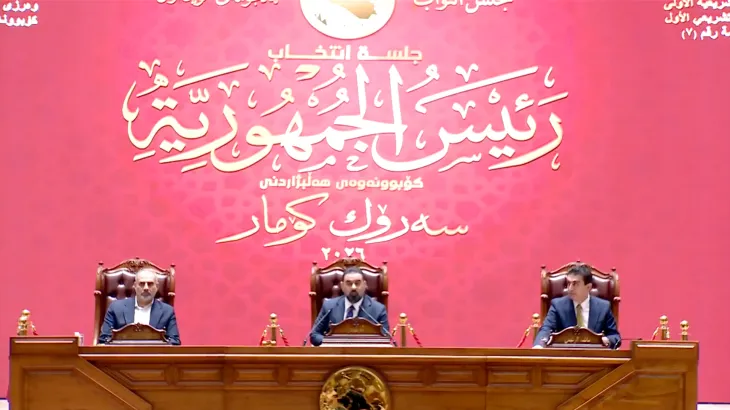
Today, the House of Representatives will hold a new session dedicated to electing the President of the Republic, in an attempt to break the political deadlock that has accumulated due to partisan differences and violation of the constitutional timings stipulated in the Constitution, amid cautious anticipation of the course of the session and what it will lead to.
The session comes after the postponement of exceeding the constitutional time limits, which brought back to the forefront the debate about the responsibility of political forces for disrupting entitlements, at a time when negotiations are intensifying, especially between the Kurdish parties, to reach a final understanding regarding the candidate who will be put to the vote.
The session to elect the President of the Republic does not appear to be governed by a single result, as much as it moves within a wide margin of possibilities that reflect the nature of the existing conflict more than it reflects a race for the position itself. One reading of the scene assumes that the session may not be held at all, if the quorum is used as an intentional obstruction tool, as part of the game of buying time and postponing the decision until further notice.
On the other hand, the possibility of going to an actual election remains, and it is a path that does not limit itself to filling a vacant position, but rather restarts the constitutional entitlements, and places the new president with a strict time commitment to appoint the most numerous parliamentary bloc, without giving way to political maneuvers outside the text.
Between these two extremes, a third, more complex path emerges, which is represented by holding the session without producing a decision, through the inability to achieve a two-thirds majority, and then emptying the subsequent round of its content, which turns the session into a formal act that does not change the balance of the blockage at all.
As for the last option, it is based on pushing for an urgent settlement, formulated under the pressure of internal realities and external intersections, and producing a consensual president with limited capacity, whose primary function is to prevent the complete collapse of the political track, not to lead it.
In light of these possibilities, the session remains dependent on the seriousness of the political blocs in transcending their narrow calculations and respecting constitutional entitlements, especially with the mounting popular and political pressures to end the state of obstruction and reactivate state institutions.