

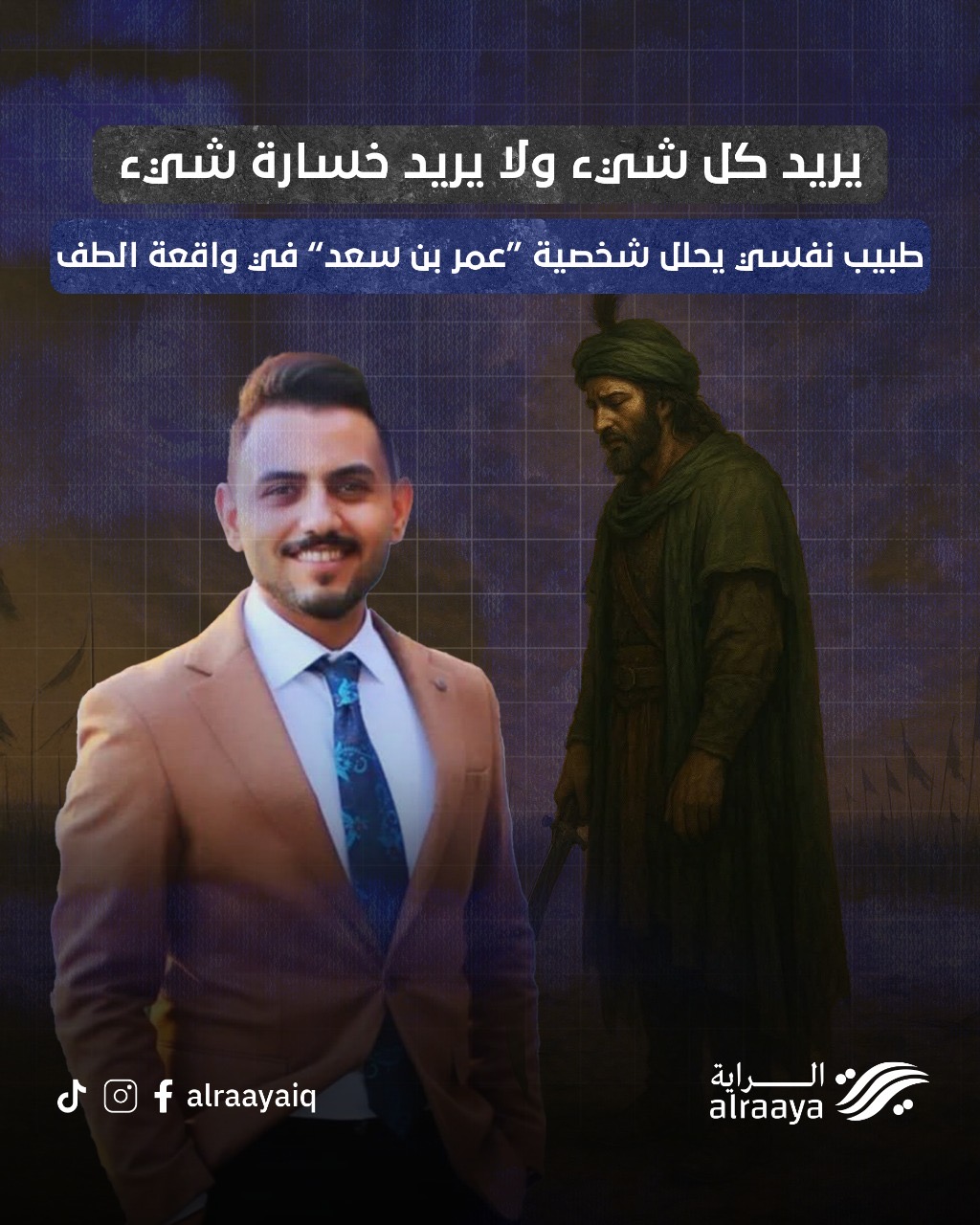
In a psychological analysis that rereads the character of “Omar bin Saad,” from the perspective of behavioral and social psychology, it becomes clear that this character is not just a historical enemy who is cursed in assemblies, but rather a psychological model that is repeated in our daily lives. Visual psychiatrist Khaldoun Iqbal called in a post on social networking sites, followed by Al-Raya, for the need to focus on the personality of Omar bin Saad in the Husseini gatherings and mourning processions, not only for the purpose of recalling the history of the battle, but also to understand the human soul and confront those moments in which a person may act as Omar did, without realizing it. Doctor Iqbal pointed out in his analysis that Omar bin Saad was neither an absolute villain like Yazid bin Muawiyah, nor a clear hero like Imam Hussein (peace be upon him), but rather he was a hesitant personality torn between the call for truth and greed for power. The visual doctor adds that for days from the third to the eighth of Muharram, Ibn Saad was experiencing an internal struggle between standing with Al-Hussein (peace be upon him) or maintaining the rule of irrigation that Ubaid Allah bin Ziyad promised him. Doctor Iqbal relied on the concept of cognitive dissonance in explaining the case of Omar bin Saad, explaining that the latter knew with certainty that what he was doing was a grave mistake, but he chose to follow falsehood for fear of his personal interest, which creates in a person internal anxiety and a state of psychological torment. The doctor also explained that Omar bin Saad represents a model of obedience to authority (Authoritarian Submission), as he submitted to the threats of Ubaid Allah bin Ziyad without conviction, submitting to a compelling authority, which is behavior that many people repeat when they surrender themselves to unjust orders for fear of loss. Doctor Iqbal's analysis describes Omar bin Saad's personality as an opportunistic-avoidant personality, which is the personality that wants to achieve gains without bearing any tax or risk, but often loses both, just as Omar bin Saad lost this world and the afterlife. The doctor confirmed that Omar bin Saad was using psychological defense mechanisms (rationalization) to justify his actions to himself, such as saying: “I am a commander,” or “the public interest is more important,” which is similar to the justifications that some people take today to justify their positions in supporting oppressors or remaining silent about corruption. The psychiatrist concluded his post with a call for the necessity of looking at Omar bin Saad as a personal mirror and not just a page in history books, indicating that the same model is repeated in our reality: • There is an employee who remains silent about corruption in order to preserve his job. • In a judge who sells his justice for personal gain. • The media distorts the truth out of interest. He stressed that the real danger lies when one of us turns into “Omar bin Saad” without realizing it.