
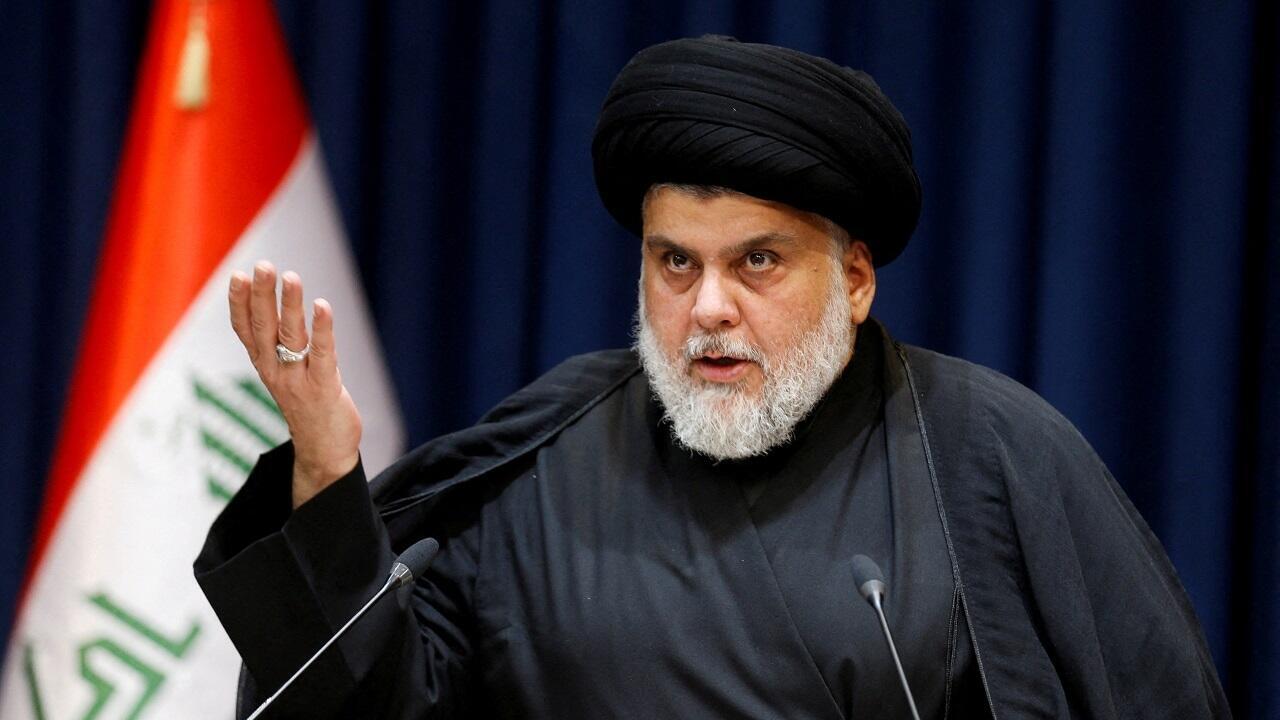
Since representatives of the Sadrist bloc submitted their resignations from the Iraqi parliament in June 2022, the leader of the Sadrist movement, Mr. Muqtada al-Sadr, has chosen the path of withdrawal from the political process as a means of pressing for comprehensive reform.
Over the following years, Al-Sadr continued to emphasize in his speeches and statements that the boycott was a principled position that would not be reversed until his conditions of “comprehensive reform and a radical change of faces” were met.
Resignation: a political earthquake
In a step described as a precedent in Iraqi parliamentary life, Al-Sadr directed the representatives of his bloc - the largest in number at the time - to submit their resignations all at once. He justified the move by saying that “the political process no longer responds to calls for reform,” stressing that keeping the movement’s representatives under the dome of Parliament does not fulfill the people’s aspirations, but rather legitimizes corruption and dependency.
From withdrawal to boycott
After his resignation, Al-Sadr's position shifted to a comprehensive boycott of the political and electoral process. He clearly announced that participation in the upcoming elections would not be possible in light of “the continuation of the same faces” and “the absence of national independence,” stressing that the movement would not be part of a government based on quotas or managed from abroad.
Repair and return terms
Over the past two years, Al-Sadr has repeated his conditions for returning to the ballot boxes, specifying the most important ones as:
• Changing the current political class and removing those who have been associated with corruption and dependency.
• Controlling illegal weapons and confining them to the state.
• Reforming the structure of state institutions and combating nepotism and party loyalties.
• Restoring Iraq’s water, electrical, and economic rights, and preventing the imposition of foreign agendas.
He stressed that “the real alternative to the boycott is comprehensive reform and changing faces, and even changing rigid minds, through political and legal means without external interference.”
Internal discipline of the stream
Al-Sadr was keen for the boycott to remain a unified position within his movement, so he issued explicit statements expelling any member or candidate who violated the boycott directives, stressing not to attack them, but completely severing the organizational relationship. This reflected his insistence that the boycott decision was not a debatable opinion, but rather a collective commitment that expressed the unity of the Sadrist position.
Between boycott and tactical flexibility
Despite the public insistence on the boycott, Al-Sadr issued practical signals that reflect political realism, such as calling on his supporters to update their electoral cards, in a move that observers interpreted as maintaining readiness for any possible change in the position if the doors to reform were opened.
Last stand
In his latest statements, Al-Sadr made it clear - through Saleh Muhammad Al-Iraqi - that boycotting the elections is not an end in itself, but rather a means to impose reform. The statement stated:
“The real alternative to boycott is to replace the current faces and remove them, in the hope that the doors of reform will be opened and the door of dependency and submissiveness will be closed... and then the doctrine will be fine, and the nation will be fine.”
Between the historic resignation of the representatives of the Sadrist bloc in 2022 and the recent position adhering to the boycott, a consistent line appears in Muqtada al-Sadr’s path: refusal to participate in elections conducted with the same faces, and insistence that comprehensive reform and changing the political class is the only way to save Iraq.
Despite hints of tactical flexibility, the Sadrist movement remains determined to this day that there will be no return to the political process except on “purely national, without subordination or subservience” conditions.