

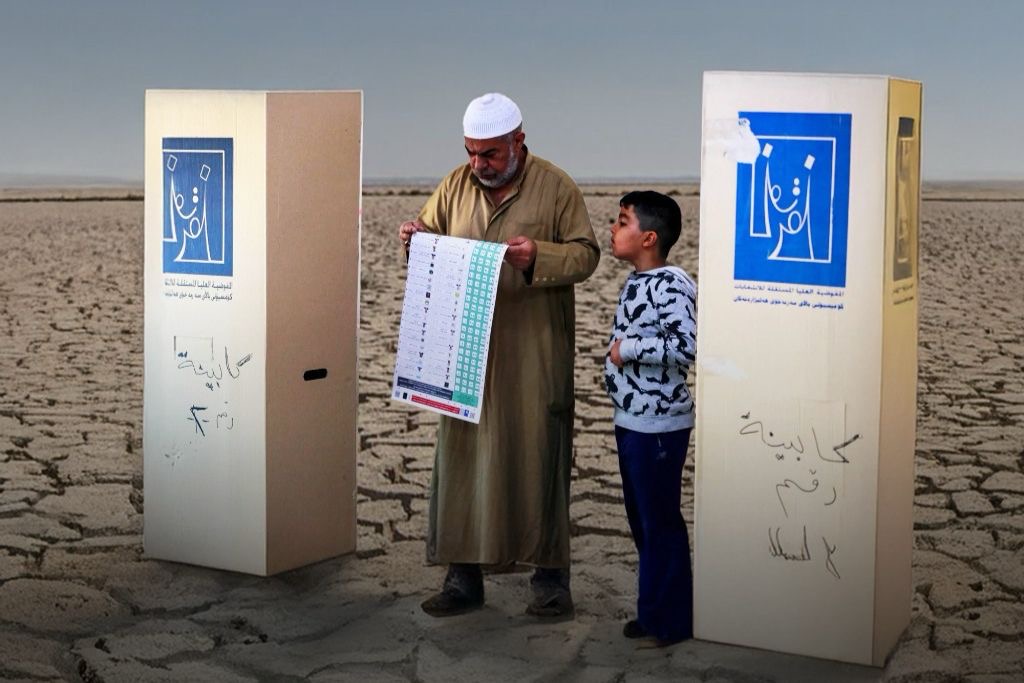
As the sun stings intensify in Basra, and under the cover of the lenience of responsible authorities, a silent killer infiltrates the citizens. He mixes salty poison with the honey of fresh water. He is the salty tongue.
Center of influence
In Basra Governorate, the problem of the salt tongue is growing, turning from a service into a human suffering that affects the lives of millions, and casts a shadow over the health of citizens, agriculture, and the local economy. Despite years having passed since the launch of the “Great Sea Water Desalination Project,” it is still vacillating between studies, allocations, and repeated promises from responsible authorities.
Salty water not suitable for drinking
The residents of Basra have been suffering for decades from the high level of salinity in the Shatt al-Arab, especially in the summer when the salt tongue coming from the Gulf penetrates, and with the absence of sufficient fresh water sources, Basra people are forced to buy it at high prices or resort to temporary solutions with unguaranteed quality.
Numbers that put the crisis in its true context
• The salinity level exceeded World Health Organization standards by shocking numbers: it reached 30,000 parts per million (TDS) in Al-Faw, 19,000 in the city center, and 5,800-6,000 in North Hartha, while the permissible limit according to the World Health Organization is only 1,000 TDS.
• Number of affected population: More than 4.5 million people suffer from a scarcity of fresh water, and most of them depend on bottled water and water transported by tankers, which burdens them economically.
• The cost of the desalination project: estimated at about $3 billion, according to official sources, and it is the largest project of its kind in Iraq.
• Expected production capacity: The project is supposed to produce about one million cubic meters per day, to cover the actual need of the governorate with the possibility of supplying the agricultural sectors with the surplus.
The desalination project... promises without implementation
The “Great Sea Water Desalination Plant” project, which is relied upon to be the strategic solution to the water crisis in Basra, is still faltering, despite more than seven years having passed since its launch. The project, which was supposed to have been launched years ago, is facing delays due to financial and administrative problems, in addition to the absence of a decisive government decision for long periods.
Legal guarantees and budgets
In its response to the crisis, the Council of Ministers agreed in May 2025 to officially refer the project, while covering the increase in costs within the 2025 budget. This step came after continuous public and official pressure, and is the first direct financial commitment at this level since the launch of the project idea.
Al-Eidani’s promises... between hope and postponement
In recent media statements, Basra Governor Asaad Al-Eidani pledged to complete the project requirements within the next few months, stressing that all technical and administrative approvals are ready, and that the project is in its final stages before implementation.
Al-Eidani added: “We are in constant contact with the central authorities in Baghdad to ensure the acceleration of procedures. Basra has suffered for a long time and there is no room for further delay.”
Despite these statements that inspire hope in the hearts of citizens, many view them with suspicion in light of the accumulation of previous promises that have not been implemented.
Emergency intervention: temporary solutions before full operation
As the crisis continued, the government was forced to take temporary emergency measures. The High Commission for Human Rights issued an official warning that Basra was facing “the worst water crisis in 80 years.”
As a result, the Ministry of Interior announced the sending of 100 free water basins to the affected neighborhoods to secure the population’s minimum daily needs.
Coordination is also currently underway to import mobile desalination plants (UF/RO) to distribute them to the most affected areas, in an attempt to alleviate the crisis before the major plant begins operating.
Latest developments: A breakthrough is near?
• The Governor of Basra, Asaad Al-Eidani, announced the imminent launch of construction work for the project after the completion of official approvals.
• An unprecedented increase in water salinity was observed this year, as the salinity level in some areas of central Basra reached 14,000 TDS, with warnings that it may reach 30,000 TDS during the summer season if urgent measures are not taken.
• An agreement was reached with a coalition of three international companies, including the Chinese Shanghai Electric Company, to implement the project on the Al-Faw coast in the coming months.
A crisis that needs a radical solution
Experts in water affairs confirm that the Basra crisis will not be solved with temporary solutions, but rather requires accelerating the completion of desalination projects and developing water transportation networks, in addition to addressing the environmental pollution that threatens the Shatt al-Arab and increases the suffering of the people.
It is noteworthy that recent years have witnessed widespread waves of popular protest in Basra demanding improved water quality and basic services, which makes the “Thirst of Basra people” issue not just a service crisis, but rather a humanitarian and security issue that could explode at any moment.