

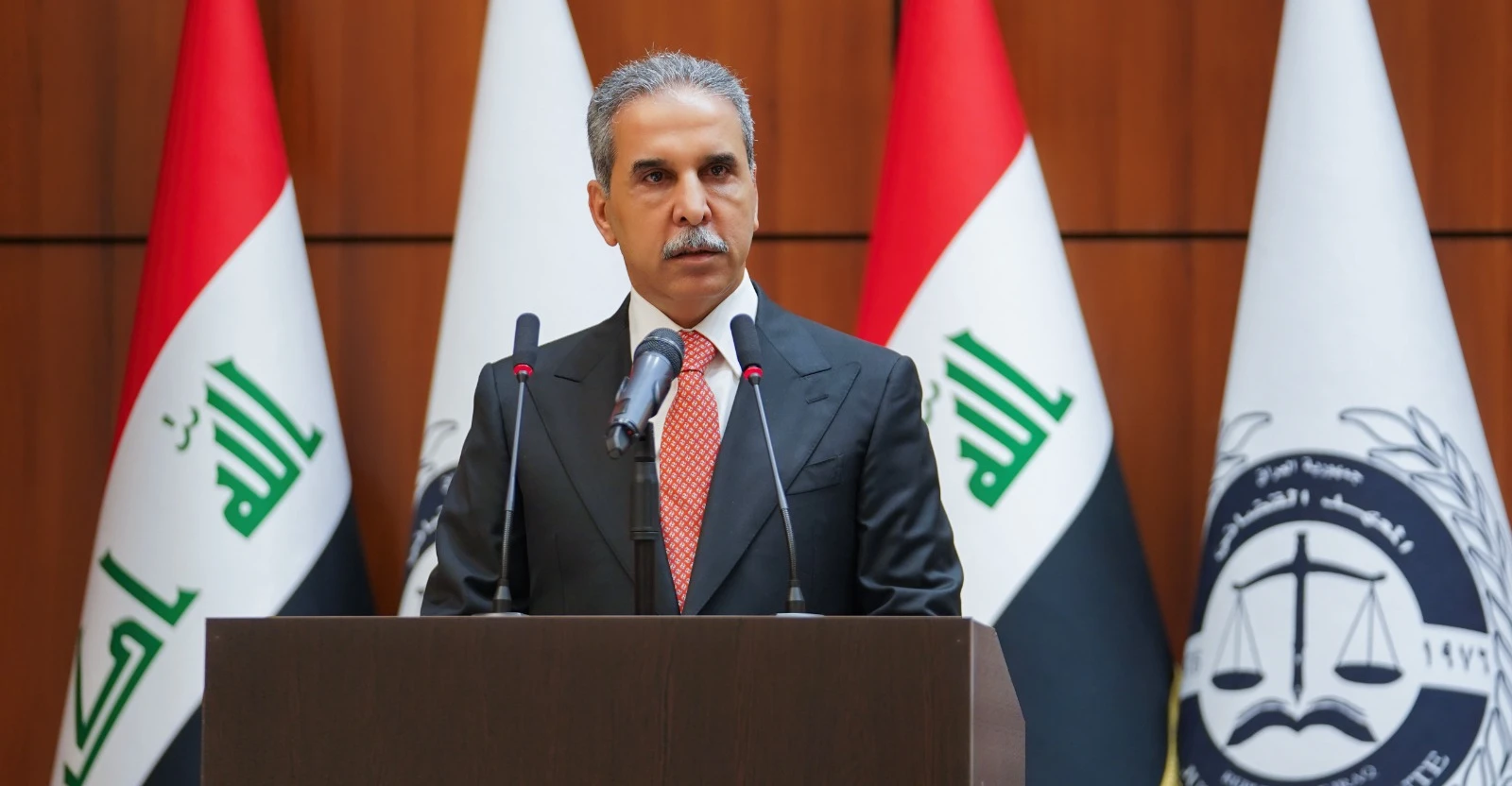
The head of the Supreme Judicial Council in Iraq, Judge Faiq Zaidan, warned on Friday of “dangerous repercussions” as a result of some armed factions unilaterally making decisions in war and peace, stressing that these actions constitute a clear violation of the constitution and place the state under international sanctions.
Judge Zaidan explained in his article that Article (61/9) of the Iraqi Constitution limited the declaration of a state of war to a complex legal mechanism involving the Presidencies of the Republic and the Ministers and the approval of two-thirds of the members of Parliament, considering that any move outside this framework threatens the democratic system and undermines the rule of law.
Full article
Declaring a state of war constitutionally
Declaring a state of war is one of the most dangerous sovereign decisions that the state alone has the authority to do, in accordance with the constitution and the law, because it has major political, military, and legal implications. In Iraq, the Constitution carefully regulated this issue to ensure that it is not misused, and to achieve a balance between protecting the state and preserving the democratic system.
The Iraqi Constitution of 2005 stipulated a clear mechanism for declaring a state of war, as this decision cannot be taken individually or randomly, but rather requires specific constitutional procedures. According to Article 61/Ninth of the Constitution, a state of war or emergency is declared based on a joint request from the President of the Republic and the Prime Minister, and then this request is presented to the House of Representatives for approval.
The Constitution requires the approval of two-thirds of the members of the House of Representatives to declare a state of war, a condition that reflects the seriousness of this decision, and aims to ensure the existence of a broad national consensus before entering into an armed conflict.
It is noted that the Iraqi constitution established a precise legal framework for declaring a state of war, balancing the necessity of protecting the state from external and internal dangers, and preserving the democratic system and preventing tyranny. This emphasizes the importance of adhering to constitutional texts as a basic guarantee for preserving the rights of citizens and the stability of the state.
The actions of some armed factions and their attempts to monopolize decisions on war and peace constitute a serious threat to the sovereignty of the state and the stability of society, and lead to legal and security chaos.
The exclusivity of these armed factions in practically declaring a state of war by engaging in activities of a military nature is considered a clear violation of the Constitution, as this right is limited to the legitimate constitutional authorities, which represent the will of the people and operate within an organized legal framework. When some factions make such decisions, they weaken the prestige of the state and undermine the principle of the rule of law.
From a security perspective, this isolation leads to multiple military decision-making centers, which creates a state of chaos and instability, and may drag the country into internal or regional conflicts without a national consensus. The spread of weapons outside the state increases the possibility of armed clashes occurring between different parties within society.
From a political standpoint, this behavior threatens the democratic system, because it bypasses elected institutions and marginalizes their role, which may lead to a loss of trust between the citizen and the state. Also, informal decisions to go to war may expose a country to international isolation or sanctions for actions that are not subject to the law.
On the social level, this situation has a negative impact on the lives of citizens, as people live in a state of fear and uncertainty, and public services and the economy are affected as a result of continuing security tensions.
The unilateralism of some armed factions to declare a state of war is a serious danger to the state and society, because it threatens national sovereignty and undermines the legal system. Therefore, it is necessary to confine weapons to the state and strengthen the role of constitutional institutions to ensure security and stability, and build a strong state based on law and legitimacy.
Fayeq Zidane
3/27/2026