
On the morning of February 28, the United States and Israel launched joint attacks against Iranian sites, including the compound of the Supreme Leader of the Islamic Republic, Ali Khamenei, whose martyrdom was officially announced in the attack. The US Central Command reported in a post on social media platforms at the time that the B-2 Spirit strategic bomber participated in the second wave of attacks at night, after the first attack that was carried out at nine in the morning.
Central Command said that the bomber was targeting underground missile stores, which was confirmed by Reuters days after the outbreak of the war, considering this a transition to the second phase of the war by targeting missile storage sites. The bombers were launched from their base in the US state of Missouri, with a range of more than 11,000 kilometers, and were carrying more than 20 tons of weapons, using the GBU-57 bunker-busting bomb, whose strikes reach a depth of about 60 meters underground.
The B-2 bomber is considered the silver bullet in the American military arsenal, that is, the last option that indicates that the usual measures are not enough, which gives a picture of the difficulty of targeting Iranian underground missile stores and the importance of this targeting (militarily) at the same time. After all, the Iranian missile program is one of the main headlines of that war, and the missiles are the most visible evidence of Iran's ability to withstand and respond militarily.
This makes the issue of Iran's missile stockpiles and the ability to launch them a vital issue in that war. And with it come important questions: Does Tehran have enough missiles to fight a long war? How do missile stockpiles play a vital role in determining the outcomes of this war, both militarily and politically?
In addition to closing the Strait of Hormuz, continuing to fire missiles for as long as possible is Tehran's main card in this conflict, as this makes the United States appear incapable of achieving its goals, or starting fires that are unable to extinguish them. Although many analysts, according to the Center for War Studies, doubted the feasibility of the Iranian strategy based on adhering to missile deterrence, the Iranian leadership still clings to it as the backbone of its national security.
This skepticism is primarily due to the decline in Tehran's ability to launch missiles in the final days of the twelve-day war last June, in addition to the fluctuation in the pace of launches during the current war. But interpreting this as a sign of the fading of Iranian missile capabilities is misleading, as it appears that Tehran, in the context of preparing for a long war, is regulating the pace of launches, especially of the most advanced missiles, by focusing on high-value targets, in order to ensure continued targeting for the first possible period.
To understand what is actually happening, it should be noted that the Iranian missile system is not limited to the inventory alone, but also includes missile production facilities, solid fuel production, and launch platforms, and each of them is no less important than the missiles themselves. Tehran has long sought to cover this system with layers of protection that make it difficult to target.
In March 2025, Iran announced what it called “missile cities,” underground facilities used to produce and launch ballistic missiles. This was preceded by two Iranian revelations of similar underground bases, while the former commander of the Air Forces of the Revolutionary Guard, Amir Ali Hajizadeh (who was assassinated by Israel during the June war last year), was attributed to saying that Iran would need two years to uncover its bases if it announced a base every two weeks.
These bases contain the most advanced Iranian missiles, such as the “Khaybar Shakan” with a range of 1,350 km, the “Qader” and “Haj Qassem” with a range of 1,300 km, the “Sejil” with a range of 2,200 km, and the “Imad” with a range of 1,600 km, all of which are capable of reaching Israel. Some estimates suggest that these bunkers may contain thousands of missiles, and that some of them reach a depth of 500 meters underground, making them indestructible. It is also assumed that each "city" has a large number of entrances, which means that destroying one entrance or tunnel does not prevent it from continuing to function.
These fortified and secret cities, in addition to Tehran's efforts to hide the launch pads and the production machinery in the background, have given Tehran's missile program great flexibility. It was not surprising, then, that American intelligence assessments recently confirmed that Tehran still retains about half of its missile capabilities and thousands of drones more than a month after the war, indicating that Iran possesses a superior ability to rebuild ballistic missile launching pads and ground fortifications within only hours of being subjected to military strikes by the United States and Israel.
The war of last June (2025) is the most important evidence of the flexibility of the Iranian missile system. At the time, the New York Times quoted Israeli officials as saying that Tehran had lost about half of its missile launchers, and the Times of Israel quoted other Israeli officials as a higher estimate of more than two-thirds, with talk about a decrease in the stock of ballistic missiles from 2,500 to 1,500 missiles, according to Israeli intelligence reports.
According to these reports, Israel bombed about 293 launching pads, including 90 that were buried in their hideouts, which explains the decrease in the number of missiles launched by Iran during this war. Israel had also targeted solid rocket fuel manufacturing sites, with a total of 12 targeted fuel manufacturing facilities out of 20 known sites for this purpose.
However, Israeli research centers that analyzed the sites that were targeted in 2025 indicated that the destruction only affected surface facilities, while the deep underground infrastructure remained mostly intact. Therefore, if we accept this narrative, the strikes severely damaged solid fuel mixing devices and missile production sites on the surface, while the underground missile cities were mostly spared.
Most importantly, Iran immediately began restoring and replacing the capabilities it lost. Last September, the Associated Press published a report about Iran beginning to restore its missile arsenal, despite suffering from a shortage of fuel mixing devices. An analysis of satellite images published by several sources, including the New York Times, confirmed the presence of renovations and construction at the solid fuel manufacturing sites in Parchin and Shahrud, indicating persistent efforts to rebuild those sites.
In an estimate of Iran's missile production capacity, a report published by Carl Barkin last September on the "Arms Control Wonk" blog concluded that Iran produces between 163 and 217 missiles per month. According to the Israeli account, by December 2025, Iran had fully restored its production capabilities, to the point that Israeli intelligence saw that striking Iran again became urgent in the following three months, that is, in the first quarter of 2026, according to what the Axios website reported.
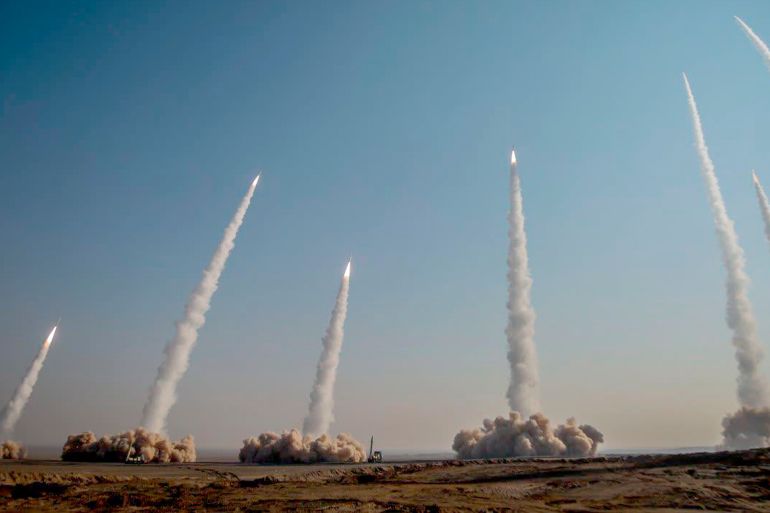
Beyond the ability to repair damage and update stocks, the method of launching missiles itself adds an additional layer of flexibility to the Iranian system, as Iran relies primarily on mobile vehicles to launch missiles, despite its ability to launch from fixed platforms such as silos and even submarines.
The reason for this is that mobile vehicles provide greater flexibility and the ability to move between multiple locations, which enhances their survivability, characteristics that make them an attractive option for Tehran, because launching from fixed bases that are vulnerable to destruction after missile launches is an unsustainable option, while missiles and vehicles can be transported away from the eyes of reconnaissance aircraft and satellites that monitor Iranian territory in search of military movements.
Therefore, the loss of launch platforms is more severe than the loss of the missiles themselves, even though Iran is using vehicles originally intended for civilian use, which makes them cheaper and easier to replace instead of relying on specialized military vehicles as launch platforms. A study by the US Naval War College suggests that the fact that these platforms are of a commercial nature makes destroying a large part of them useless at the strategic level, as they can be replaced in the long term. Their destruction may affect Iran’s ability to launch in the short and medium term, but they remain easily replaceable in the end.
Despite Tehran's efforts to protect the launch bases, Israeli sources reported that in the first three days of the current war, Israel destroyed half of Iran's missile launchers. But this data also remains questionable, as Israelis and Americans often overestimate their military achievements for political reasons. Without mentioning that Iran has adopted a new tactic in this war by deploying fake launch pads to distract the striking force from the real launch pads.